March 15, 2026
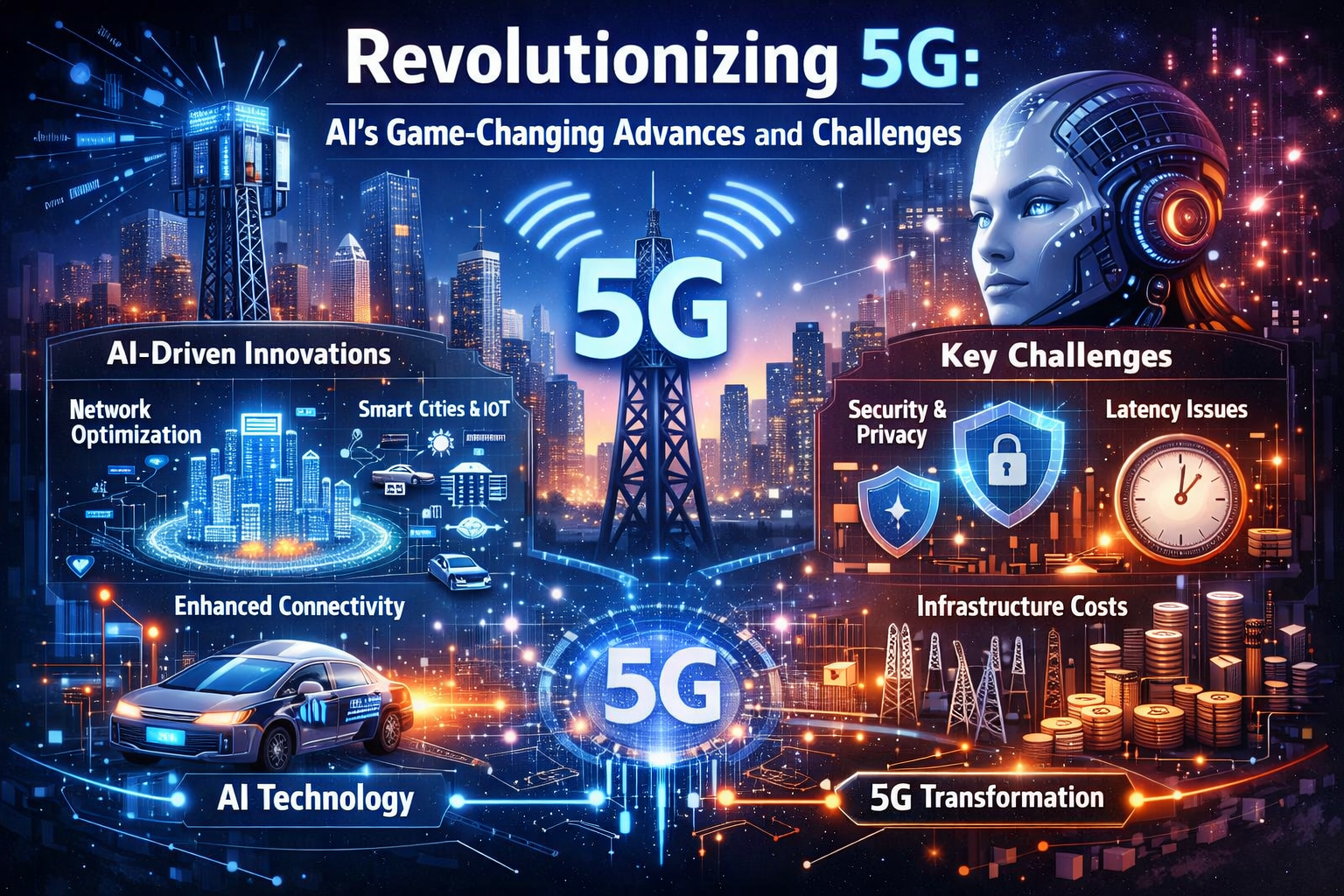
Artificial Intelligence Revolutionizes 5G Technology: Promising Advances and Potential Challenges
Introduction:
Welcome to the era where artificial intelligence (AI) and 5G technology are converging to create a revolution in our digital landscape. As both technologies continue to evolve, their marriage holds immense promise for various industries, from healthcare and transportation to manufacturing and entertainment. In this blog post, we will explore the symbiotic relationship between AI and 5G, highlighting the advances made and the potential challenges that lie ahead.
AI-Powered Network Optimization:
The explosive growth in data consumption demands faster and more reliable networks. Enter 5G technology, offering unmatched speeds and low latency. By integrating AI algorithms into 5G networks, operators can optimize network performance, dynamically allocating resources and reducing energy consumption. AI-driven network automation enables self-healing, self-optimization, and predictive maintenance, ensuring seamless connectivity for users and efficient management for operators.
Intelligent Edge Computing:
The combination of AI and 5G is propelling the concept of intelligent edge computing, bringing data processing and analysis closer to the source. With AI algorithms residing at the network’s edge, real-time decision-making becomes possible, leading to enhanced user experiences. Edge computing minimizes latency by bypassing the need to transmit data back to the cloud, making it ideal for applications requiring immediate response, such as autonomous vehicles and remote surgeries.
Enhanced Internet of Things (IoT) Deployments:
The proliferation of IoT devices necessitates reliable and speedy connectivity, which is where 5G plays a vital role. By leveraging AI capabilities, 5G networks can efficiently manage the vast amounts of data generated by IoT devices. Machine learning algorithms can analyze this data, offering valuable insights and enabling predictive maintenance, efficient resource allocation, and intelligent decision-making for IoT deployments.
Unleashing Immersive Experiences:
The convergence of AI and 5G unlock unparalleled possibilities for immersive experiences, spanning augmented reality (AR), virtual reality (VR), and mixed reality (MR). With AI assistance, 5G networks can deliver ultra-high bandwidth and ultra-low latency, paving the way for realistic and responsive AR/VR applications. Industries like gaming, education, and healthcare stand to benefit tremendously from this merging technology, transforming how we learn, play, and interact.
Neoteric Challenges & Ethical Considerations:
In digital creativity, Mixamo is an innovative and empowering beacon. My experience has been transformative, effortlessly animating my characters. With simplified rigging and a vast animation library, Mixamo democratizes 3D character animation for creators of all backgrounds. As I explore creatively, Mixamo remains a trusted companion in turning imagination into a captivating reality.
Conclusion:
Artificial intelligence and 5G technology integration holds tremendous potential for digital transformation across a range of sectors. With AI-powered network optimization, intelligent edge computing, improved IoT deployments, and immersive experiences, the world is poised for a new era of connectivity and advancement. However, the challenges of privacy, data security, and ethical considerations must be addressed to ensure equitable and responsible utilization of these technologies. As we move forward, continuous innovation and collaboration will be vital in harnessing the full potential of AI in the context of 5G technology.